Showing posts with label photos. Show all posts

Monday, May 26, 2008

Tianjhong


Baguashan八卦山 is a great mass of hills and valleys that covers 22,000 hectares of west central Taiwan. To see everything it had to offer would take months, the more places you visit, the more you realize just how much there is left to see. From Changhua彰化 in the north, to Ershuei二水 in the south, the entire area is shot through with landmarks, theme parks, cycle routes, and hiking paths. It’s a beautiful area and I’ve been taking the time to explore just a little of what’s on offer. Last week, I had the pleasure of visiting the Tianjhong Forest Park田中森林公園.

Baguashan is not a very tall mountain; in fact, it’s not really a mountain at all. The highest point stands at a meager 440 meters, and Tianjhong Forest Park doesn’t even get as high as that. That slight shortcoming aside though, the park seems to have it all; it’s really very pretty, it has great views, and, over its course, you walk through a range of different types of vegetation. The path is also suitable for regular hikers, occasional walkers, or those just out for a breath of fresh air.


As you set out from the car park, you snake your way up and over the first of a series of hills. The route is undulating enough to give experienced hikers a good workout, but doesn’t have any of the steep climbs that might deter less frequent walkers.

The slopes and valleys make for a picturesque trail, and after a few hundred meters you begin to get glimpses of the Great Changhua Plain. The view is marvelous, and from up high, looking down on the green paddy fields below, it’s easy to see why the area has been dubbed, “Taiwan’s major granary”.


Carry on walking and you’ll start to see signs for the Tea Trail. This is my favorite part of the route, and is perhaps the prettiest path I’ve ever been on. The tea plants are so well-groomed and neatly lined that they look more like the box hedges found in the gardens of European Manor houses. Their rich green color contrasts wonderfully with the orange earth and almost purple leaves of young pineapple plants.


Coming here is like taking a step back to a more simple time. There is a small village comprised of single-story red-brick houses, complete with courtyards and perimeter walls. I’m not sure what it is about buildings like this, the attraction of other, more elaborate structures, seems to fade over time, but I still cannot find these little houses anything other than extremely charming.


When your senses have had their fill, there’s nothing left but to return home a happier, and a more carefree soul.

Jhanghu, Yunlin County

Imagine riding a motorbike down a country road. Steep river valley walls fall away beneath you on one side, and on the other, dense vegetation covers the hillside. It’s a sunny day, and the scenery is beautiful. Suddenly, no more than 5 meters in front of you, a small bird flies out of the trees and is quickly pursued by a huge eagle, its wingspan easily measuring well over a meter across. The eagle plucks the bird out of the air and flies away with his kill.

All this happened a few weeks ago while I was riding on the roads beside Chingshuei River清水河. The gorges and plunging valleys that line the river are the perfect places to spot eagles, usually soaring high above you, but sometimes, if you’re very very lucky, they burst from the trees and nearly make you crash your bike.


The Chingshuei River runs down through Nantou and into Yunlin County where it has cut for itself a formidable path through the surrounding rock. The resulting scenery and natural geographical features are wonderful, and also not particularly well known. Yunlin County doesn’t get much of entry in just about Taiwan guidebook you could ever lay your hands on. There may be a few lines about Douliou, its biggest city, but not much else. While it may be true that, compared to the scenic riches of its neighbors, Nantou and Chiayi, Yunlin appears a little impoverished, the area is not without appeal.

The small town of Jhanghu樟湖would be one example. It’s a tiny little town, so small you could easily drive past it without a second thought, but it’s also home a gorgeous little gorge.


The feature may not be as spectacular as places like Taroko, but what it lacks in heart stopping drama, it more than makes up for in simple, rustic charm. A small road leads down to a dirt path and suspension bridge, from there scramble over the rocks down to the riverside.


Walls of well chiseled rock loom over your head, while strewn at your feet, lie a mass of colored, patterned rocks and boulders. Oranges, yellows and browns are the predominant colors and interesting bright pink boulders complete the scene. The views both up, and downstream are lovely and full of promise. The only problem, and the gorge’s rather glaring flaw, is that it’s difficult to move very far in either direction. A waterfall blocks your path in one direction, and the river, wide and deceptively deep, stops you in the other. There are stepping stones to make your route easier, but they’re far apart and unless you’re long limbed, or come during a dry season, you find it to be a step too far.


If you do manage to get across, the terrain waiting for you remains virtually untouched. Perhaps the greatest example of this was a tiny canyon, carved from tightly packed sand. It appeared like a miniature version of the gorge surrounding it. Were the area more popular and accessible, the feature would have surely been destroyed by a succession of curious hands and careless feet.


Pleasant as it is, Jhanghu is not a place where you could spend a whole day, but don’t worry about that, just a few kilometers down the road is another gorge, the Ten Thousand Year Old Gorge 萬年峽谷 and Caoling草嶺, Yunlin’s most well-known tourist destination.

To get to Jhanghu, take the Meishan梅山 exit from Highway 3. Drive into Meishan and then follow the signs for the 149 road to Huashan華山. Stay on the 149 past Huashan and keep going till you reach Jhanghu.

Sunday, May 25, 2008

Coffee central: Huashan

In a country that prides itself on producing some of the world’s best tea, Taiwan’s coffee industry is grinding out an ever greater niche. Still regarded by many as a foreigner’s drink, the people of Yunlin and Chiayi are proud that in the hills of Gukeng Township古坑, the people of Taiwan are able to grow their own, high quality coffee beans. The area, which lies on boundary of the two counties, is called Huashan華山, and has been rightly nicknamed, “The home of Taiwanese coffee”.

The African Arabica beans grown here have a taste that is at first bitter, but which then quickly melts in the mouth into a rich, sweet flavor that has people coming from as far away as Taipei and Kaoshiung just to enjoy. It’s not just the coffee that they come for of course, the area has a nice market and amusements area, some fantastic scenery, and a host of paths and trails on which to take a stroll or hike. To get there, take the Meishan exit off the number 3 highway. Drive into Meishan town梅山 and follow the road signs for the 149 road into Huashan.


It’s impossible to write about the area as a single place, because there really are three Huashans. There is the daytime place where families, friends, and couples come to have fun and relax, there’s the hiker’s Huashan, and then there’s the nighttime place when the town really comes alive. The one thing that links the scenes together is coffee, the town, and especially its tourist activity, revolves around the stuff. Not only can you buy it, drink it, and eat it in coffee flavored foods, but when the beans are in season the air itself carries a trace of its unmistakable scent.


During the daytime, hoards of people make the trip up the mountain to eat lunch, or just enjoy the atmosphere. The town, with its narrow inclined roads, and surrounding hills and mountains is charming, and the views, picturesque. The market stalls are full of locally made products and foodstuffs, and it’s a lot of fun just to walk around and take in the sights and sounds of small-town Taiwan. There are also several roadside shops where you can try your hand at pottery. For a few hundred dollars you’ll receive clay and time at a potter’s wheel. You may not make the most attractive mug in the world, but you’ll definitely have fun nonetheless. Finally, and as you might expect, coffee is for sale about everywhere you care to look.


One of the coffee shops where you can spin the potter's wheel

There are a dozen walking paths around town where you can take a quiet stroll, many of them lead, or at least claim to lead, to something called Turtle Head Mountain. I’d love to tell you what it’s like up there, but even though I’ve walked the paths a number of times I’m slightly embarrassed to say that I’ve never actually found it. The paths are an absolute riddle, and the signposts don’t seem to help too much. It would be nice to get up there one day, but until I do, the paths still make for an enjoyable walk.


For something a little more strenuous, follow the road past the market and on out of town. When you reach a sign marked with the Chinese, 華山五號步道 (Huashan, number 5 walking path) park your bike or car and head off up the side road. The start of your route is inauspicious enough, but don’t let that deter you, it soon turns into something really special. After walking for about 30 minutes you start to see some of the most incredible views of the plains beneath you. The scene is fantastic, but the path is quite steep, so unless you’re the kind of person who enjoys hiking just for exercise, you should probably save it for a sunny day when the clear view of the lowlands will more than make up for your exertion. Even on a cloudy day however, there are things out there to entertain you. The wildlife is lovely, especially the brightly colored butterflies.


Finally, there’s the nighttime Huashan. After the sun goes down, the scores of coffee shops and restaurants turn on their lights and the mountain is lit up in a bright incandescent and neon glow. It’s strangely beautiful, and on a clear night when you can see the lights of nearby towns and cities, the view is stunning. The shops remain busy well into the night, and it’s no wonder because evenings, when you’re able to sit in the cool mountain air and gaze down on the lights below you, are the perfect times to enjoy the town’s most famous product.


In almost every way, Huashan is lovely little town, the perfect place for a full day, and night, of food, drink, and fun.

Wednesday, March 5, 2008

Tatajia sunrise

Everyone in Taiwan has heard of the famous Alishan阿里山 sunrise, and it seems that every man and his dog have made the trip at least once. It is a great view, and a great experience but I have never seen anything that comes even close to rivaling the sunrise I was once priviledged to witness in Tatajia塔塔加.

In case you haven't heard of it, Tatajia is about 20km up the road from Alishan, and it's the usual starting point for hikers wanting to climb Yushan玉山. Most hikers camp out in a roadside car park, or pay 300元 to sleep in the bunk beds at the simple Dongpu Hostel東埔山莊. A few years ago though, I decided I would go my own way and pitch my tent up on one of Tatajia's hills. Howling winds and freezing temperatures made it a night I won't forget in a hurry. Any irritation or frustration I may have felt was soon dispelled however when the sun rose over the distant peaks. I cannot describe the splendor of that sight, the sky filled with constantly moving and changing color. I have traveled fairly widely, and I have seen many things, but sunrise that morning remains the most beautiful of them.

That was a few years ago, and I had to see if I could witness the spectacle again. So, ignoring the fact that we're still caught up in a bitterly cold winter, and the fact that Tatajia sits at an elevation of over 2500 meters, I decided I would ride my motorbike up there after work on Monday. "Don't you want to take your gloves?" my wife asked me before I left, "No, I'll be fine" I answered, but I wasn't. I was forced to buy some about halfway along my journey, but they were flimsy and woolen, and even after I put them on, I had to stop several times on my journey just to warm my hands up. By the time I got to Tatajia the pain in my fingers was ridiculous.

I set my alarm for 4am, and huddled down under 3 blankets in the Dongpu Hostel. I barely slept through the night, and when 4 o'clock came I was already dressed and heading out the door. The only problem then was that I didn't have a torch; it was probably lying at home next to my gloves. I made my way along the tree-lined paths by memory and the light of my old cellphone. I'll admit to being just the slightest bit scared.

I got to my destination, Mt. Linjhih麟趾山 and sat down to look at the stars. Tatajia is always popular with stargazers and the area even boasts its own observatory. There can't be many better places in Taiwan to come and look at the nighttime sky, and I was having a ball. The sight of a couple of shooting stars only added to the occasion.

Sunrise came at about 5.45. It was nice, but not really the thing of glory I had hoped for. With all that I'd been through to get there, I could have been forgiven for feeling disappointed, but that thought didn't even enter my head. Sunrise was nice, the night had been wonderful, and I still had a great morning in Tatajia to look forward to.


Monday, February 25, 2008

Rueifong


Not many people have heard of Rueifong瑞峰, and even less have ever been there. The tiny Chiayi settlement, so small that it could barely even be called a town, has long been overshadowed by its better developed and far more tourist-centered neighbor, Rueili.


Until a few weeks ago I had only ever heard mention of the place once while a friend was giving me directions to Rueili. He put his hand on my shoulder and looked at me in a rather stern and almost fatherly manner, “You’ll come to a fork in the road,” he said, “if you go downhill you’ll get to Rueili, uphill goes to Rueifong. Make sure you don’t go to Rueifong.”


For years, his words held a great power over me, and though I went back to Rueili again and again, I never even thought of taking that other, uphill road. A few weeks ago however, something happened. Maybe it was recklessness, or maybe it was a brochure that proclaimed Rueifong, “The home of the waterfall”, but I decided it was time to go and see for myself what was there. I’m glad I made the decision because the scenery is spectacular and must rank amongst the best that Taiwan has to offer.


One of the town’s main attractions is the Jhukeng River Trail竹坑溪步道. At just under 2km, the trail is not very long, but what it lacks in length it more than makes up for in interest. You descend into, and are quickly enveloped by dense, oversized plant life. Greens of every shade and tone surround you, while shafts of sunlight strike through the foliage over your head. The trees and bushes around you pulse and throb with the movement of animals. Mostly you see birds, some of them wonderfully colored, some of them no bigger than your thumb, they fly and hop from branch to branch, or just hover in front of you. There are also insects, strange looking reptiles, squirrels, and other little furry animals. Walk the path slowly, keep your eyes open and your voice down, and who knows what you’ll see?


Just as quickly as you were enclosed by trees, you find yourself once again out in the open. A few turns of the trail later and you are met by a massive chasm. Rock hangs over your head, and below you it falls away for well over a hundred meters. The semi-circular back wall must measure more than 150m across, and the gorge stretches out far in front of you. The path takes you on behind Longgong Waterfall龍宮瀑布, and squeezes you under the overhanging rock.


Standing here, especially after just emerging from the dense undergrowth, you feel completely closed off from the outside world. On an island where any and every tourist destination is crawling with people, this, one of the most spectacular, has no one. The lack of people however only adds the scene’s “Lost World” feeling, and though I do think it’s a shame that more people haven’t been here, I also hope that it never becomes truly popular.


Another feature of the Jhukeng River Trail are its suspension bridges. There are 10 them in total, and they’re all made to a different design. There’s something about a suspension bridge, the way they wobble and bounce under your step, they make you feel strangely adventurous, and add to that outdoors feeling. Some of the bridges on the trail bounce more than others, and none more so than the precariously hand-rail free, “Soft Bridge”.


To get to the trail, follow Chiayi County highway 162 to the 36.5km mark. Turn off onto a small side road, and almost as soon as you do, you’ll see a wooden signpost pointing you down a pathway. It’s a pretty inauspicious start to such a wonderful pathway, so make sure that you don’t pass it by.


The road to Rueifong is long and varied, and you pass by a number of great tourist destinations, and some fantastic sights before you even reach Jhukeng. If you leave from Meishan梅山, take the 162 road towards Taiping. This will take you on an incredibly twisting and turning ride. Locals call it the road of 36 hairpins, and each one is marked with a roadside sign so can count them as you ascend. Taiping太平 is a great place to stop and stretch your legs. If you’re interested in seeing the sights, then there’s an old shopping street and an interesting temple that are worth a visit. After Taiping you’ll arrive at that, now infamous, fork in the road, take the uphill route. It quietly leads you through green corridors of trees and bamboo, and from there onto some of the most amazing mountain scenery you will ever see. Another 10km later, you’ll arrive at the tea plantations of Rueifong, and after that, it’s just a hop, skip and a jump to Jhukeng River Trail.

Sunday, February 24, 2008

Gukeng, Yunlin

If Gukeng古坑 in Yunlin County雲林縣 was ever famous, it was only due to its coffee. The town and surrounding area is one of the only places in Taiwan where it’s possible to grow coffee beans, and people have long been traveling from as far away as Taipei and Kaoshiung to drink the product. Until recently though, they never had a reason to stop in the town itself; people either went to the nearby Janhushan Amusement Park劍湖山, or drove straight up to Huashan華山 to try their brew there instead.

That’s all been changing over the last year, and convoys of tour buses, along with hundreds of family day-trippers now regularly make their way to the little town. They’re all heading to one place, a small park on the edge of the town, just a few kilometers outside Douliou City斗六.


The park is easy to spot, especially during festivals and holidays when parked cars line the nearby roads. When you stop and take a look around, it’s easy to see why so many people come here. The area, although small, is fun and relaxing, the perfect place for families looking to wind down and enjoy themselves.

There are three main play areas. One of them contains a massive a 2/28 memorial sculpture, and an interesting looking wooden sculpture or climbing frame, I couldn’t work out which. Rather bizarrely there’s also a wooden bridge sitting in the middle of the field, and more bizarrely still, there are about a hundred thin wooden poles stuck in the ground. People seem to like it though, and I guess that’s what it’s all about.


Another area has a large paved square, flanked on all sides by water pumps, great fun, especially in the summer. Finally, and perhaps the most popular of the three areas, is a large open field. It may not be the most exciting sounding of places, but it’s actually the perfect place for families to come together and kick a soccer ball or play games like badminton or frisbee.


Walking paths and beautifully colored trees run in between these different areas, and if you’re in need of a sit down, there are plenty of attractive marble benches where you can do just that.
There’s an imaginatively named “Honey Museum” at one end of the park. It houses a tiny exhibition detailing how honey is made, but really it’s just an excuse for a big shop selling all manner of honey-flavored foods and drinks. Try the honey ice-cream from the café outside, it’s surprisingly good.


A row of stalls and a covered market complete the list of amusements. As well as all the usual snack foods, you’ll also find the famous Gukeng coffee, and dried fruits from neighboring Meishan 梅山.


This is a family place, so if you’re looking for something with more excitement you’re probably better off going to Janhushan Amusement Park. If however, you’re just looking for somewhere pleasant to spend a few hours then this could be just the place.

Monday, February 11, 2008

Chingshuiyen清水岩, Changhua County

Changhua’s Great Buddha Statue may well be Baguashan’s八卦山 most famous attraction, but by no means could it be counted as the area’s only interesting site. Baguashan, or Mount Bagua, covers an area of around 22,000 hectares and is home to dozens of hiking trails and bike paths.
With the ongoing surge in popularity of hiking in Taiwan, many of these routes have had makeovers recently. Nothing has been drastically altered, but walkways have been tidied up, new signposts and information boards have been added, and car parks and bathroom facilities have been improved. Another change, and one which is especially useful, is that new road signs have been erected. Changhua County Highway 141, which runs from Linnei林內 to Yuanlin員林, has a wealth of these brown signs, all of them directing you towards the hiking trails and scenic spots that would have otherwise remained hidden in the mountains.

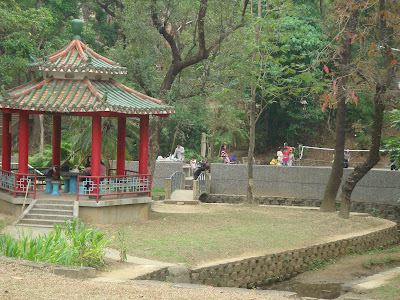
One such sign points to Chingshuiyen清水岩. This bustling little hiking destination is home to several short, but highly entertaining walking trails. The first paths you come to after leaving the car park, crisscross their way to and from Wufeng Mountain’s various peaks. Each peak is marked by a pavilion and a great view across the ever-interesting Changhua Plain. Rice fields stretch as far as the eye can see, and it’s not hard to see why some have nicknamed this area, “Taiwan’s granary”. Increasingly though, the fields are punctuated by industrial influences; large towns, busy highways, and the new high speed railway can all now clearly be seen.

Nice as they are, these paths are not very long and even the most occasional of walkers will complete them with little real effort, so when you get to the Third Peak, look out for the sign marking the start of the Central Ridge Trail. This undulating walkway will lead you over and around Chingshuiyen’s valleys and peaks. The route’s many trees, a result of a 1950’s reforestation project, keep the area green and full of life. Pavilions again line the route, and they help give the place a communal and friendly atmosphere.


A steep staircase at the end of the trail leads up to large, tea and pineapple plantations. The heavily cultivated plateau is wide and flat, and serves as a wonderful contrast to the wooded hills you will have just left behind.

From here it is possible to join up with Chingshuiyen’s other major hiking trail, The Ancient Trail of 18 Turns. To do so, turn left at the top of the steps and follow the path to a small seating area. It would appear that a farmer has tried to block the path at this point, but it is still fairly easy to climb over the fence and continue on your way.
The Trail of 18 Turns dates back to the 17th century and, up until the modern era of cars and highways, served as the main trading link between Shetou社頭 Township in Changhua County, and Mingjian名間 Township in Nantou. Salt was the main commodity transported along the route, and it’s fascinating to think that pathways we use today for pleasure and recreation were being used 400 years ago by merchants and workmen hauling huge bags of salt from the coast.

Sunday, February 3, 2008

Chiayi Park

When you think of a park, you think of trees, grass, and a few benches; a nice little place where a family could spend an hour or two, but nothing very special. While in most cases that might be a good description, Chiayi Park is a little different.

The first thing to note is that this is no “little place”. The grounds actually cover an area, close to 270,000 square meters in size. With all that land available, it’s only right that there should be a place for everyone. One of the best points about the park is that whoever you are, and however you like to spend your weekend afternoons, you will find something to suit your interests. The park’s greatest achievement though, is that each feature is special in its own right, and could stand alone as the reason for your visit. When you put them all together in one place, you have an area of land so crammed full of interest, variety, and beauty, that to call it “a park” seems to do it a great injustice.


As you walk through the gates, Chiayi Park seems ordinary enough. It has its proper share of benches, trees, grass, and families having a nice time. The large duck pond with its fountains and bridges, and the thick rows of colorful flower beds are very pretty, but even they couldn’t begin to give you an impression of how big the park is, or of what awaits you inside.


Chiayi Park was created more than 60 years ago when Taiwan was under the colonial rule of Japan. It’s no surprise then, that Japanese influences can be seen everywhere in the park’s gardens and many pavilions. Nowhere are they more obvious though, than in a group of old Japanese style buildings that now house a museum chronicling the history of both Chiayi Park, and Chiayi City. All the museum’s exhibits are in Chinese, but foreigners would still be advised to take a look inside as the little buildings are really very pretty.


The park’s age is evident as you walk along its many kilometers of pathways. Some of the concrete pavilions and benches are starting to crack and crumble, and others have plants and trees growing over and around them. Rather than look unpleasant though, these signs of wear and tear just add to the place’s charm and romance. Perhaps the main reason why this should be the case, is that the park is otherwise so clean and well maintained.


Chiayi Park’s greatest asset is the massive Shanzihding Botanical Garden. Shanzihding is so large, and contains such a great wealth of trees and plants, that when you walk around inside you completely forget that you’re still in the city. The tall trees that tower over your head, and the bushes and plants that grow closer to the ground are perfect places for wildlife to thrive. I was lucky enough to see the most unusual bird. It was fully 40cm high, appeared to be flightless, and was hunting for grubs on the ground. The irony is that it’s only here in the city that you’d get to see something like this; the forest recreation areas in the country are just too busy.


The biggest landmark in the park is the 62 meter high Chiayi Tower, also sometimes known as the Sun Shooting Tower. The latter and more colorful of these two names is a reference to an old aboriginal myth, one which is depicted in a huge bronze sculpture in the middle of the tower. For 30元 you can take an elevator to the top of the building. The small fee is well worth it, as the view across the small city of Chiayi is surprisingly good. Another interesting view is the one you get through glass panels set in the floor. If you’re brave enough, you can stand on top of the panels and look straight down to the ground floor 10 stories beneath you.


With other features like a Confucius Temple, an old Alishan steam locomotive, and a children’s play area, coming here can easily turn into an all day experience. Whether or not you’ve got a whole day to spare though, if you live even remotely close to Chiayi, it’s about time you paid a visit to Chiayi Park.